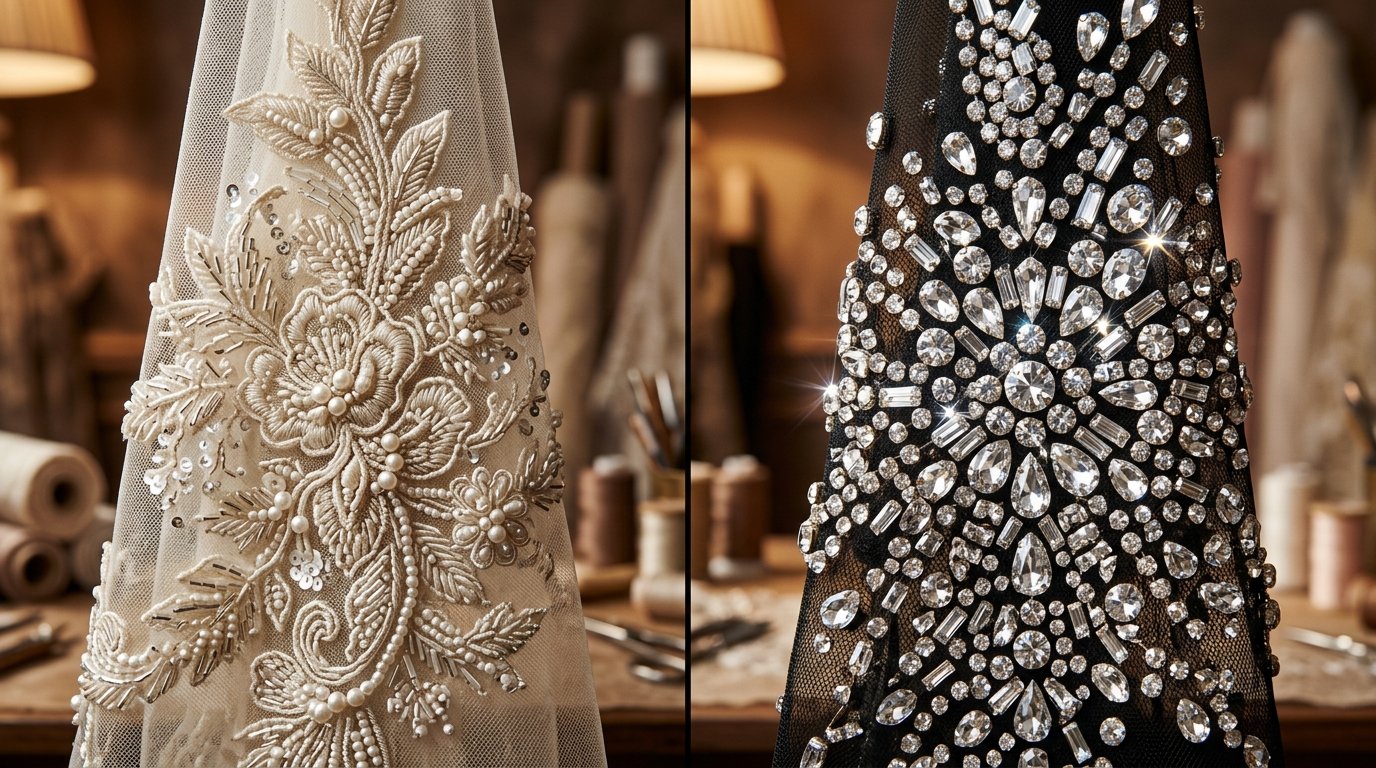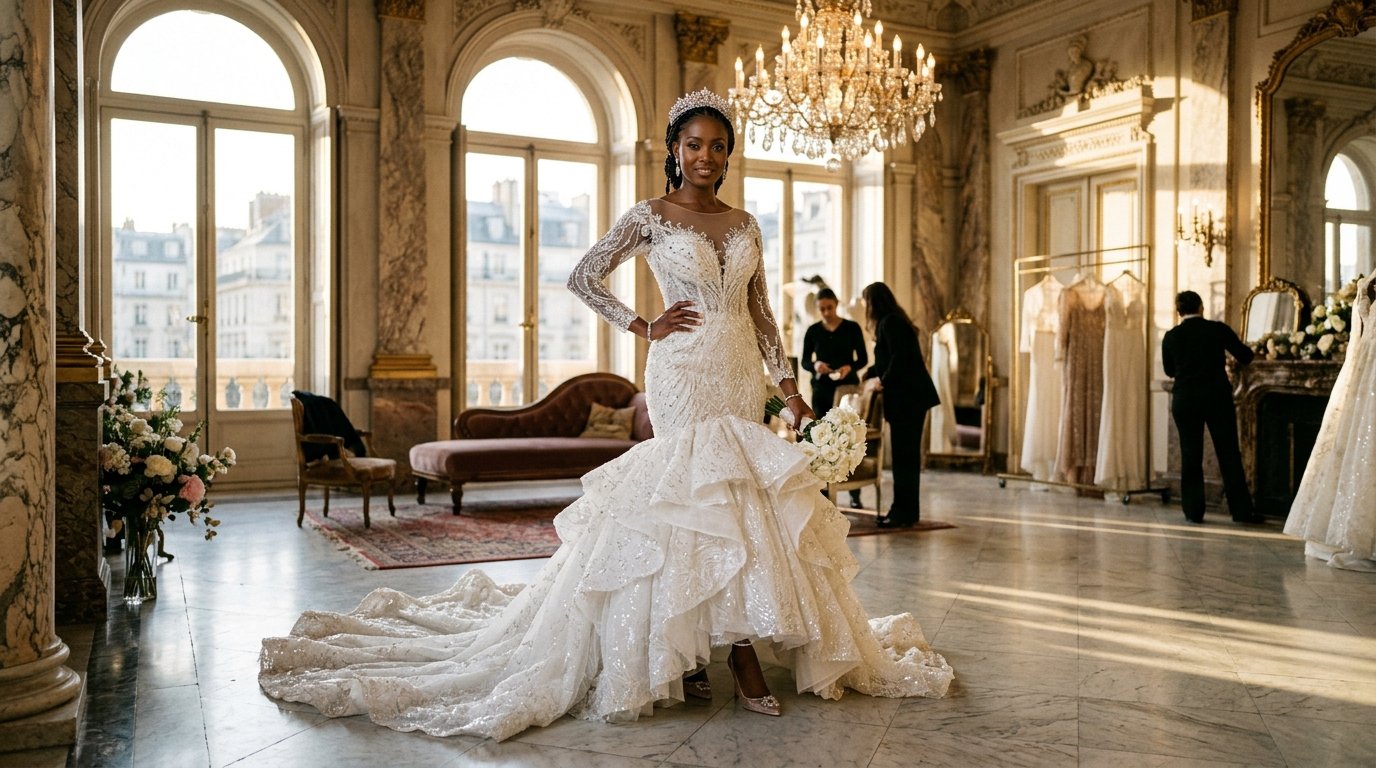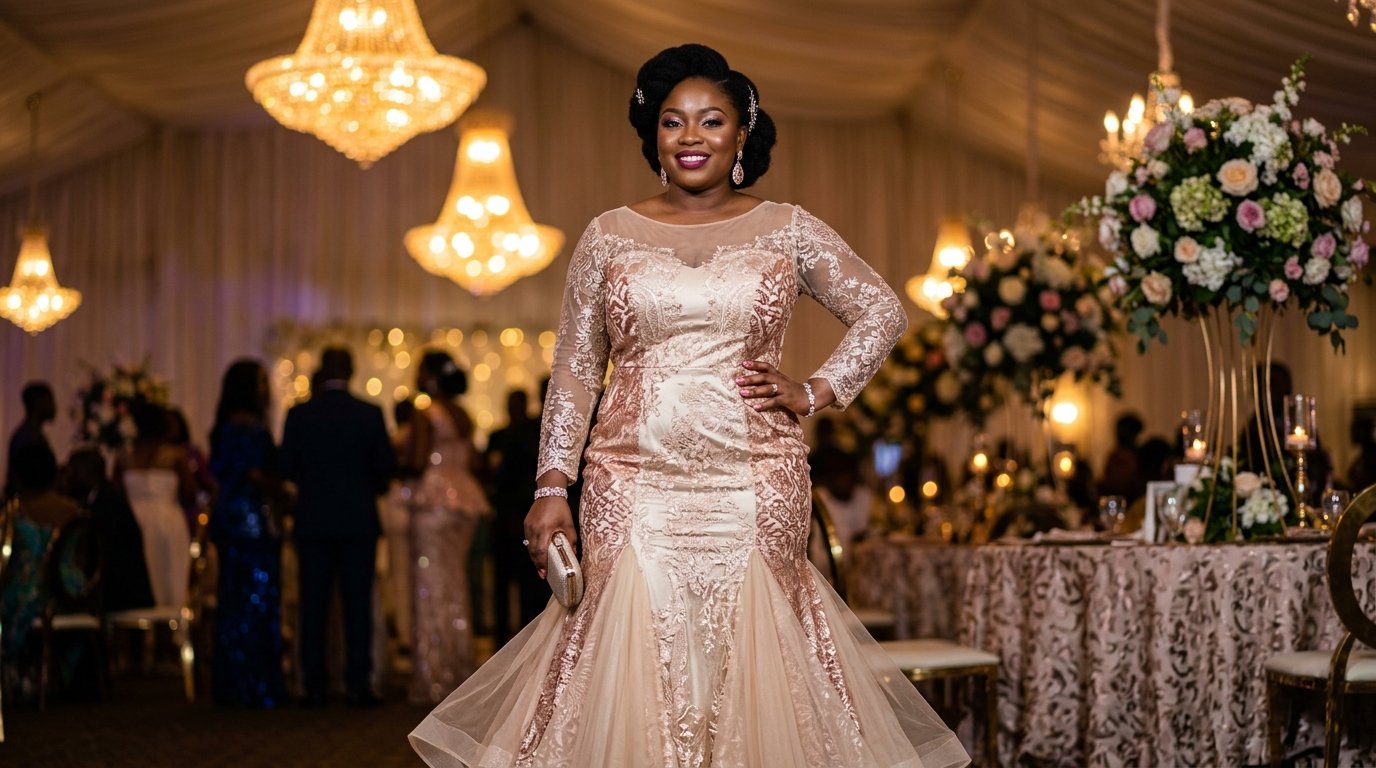
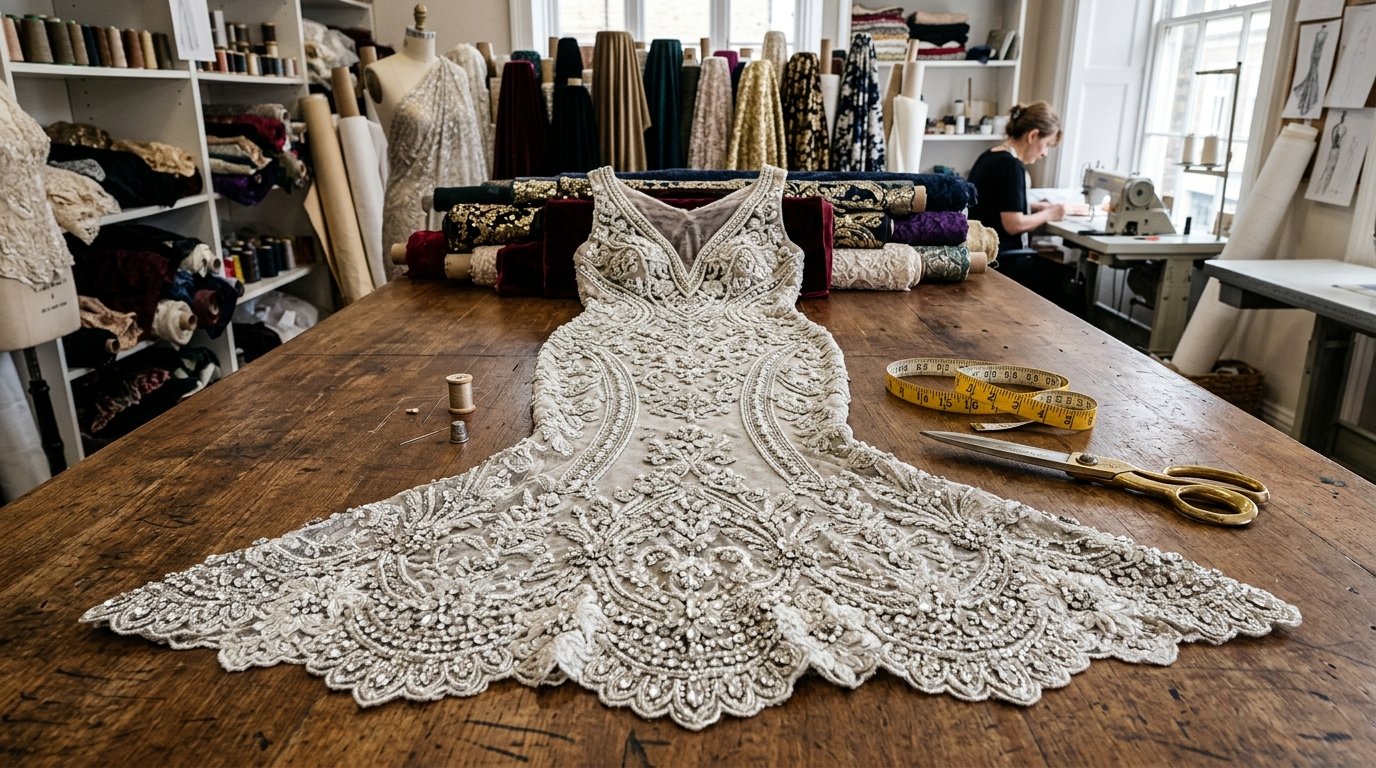
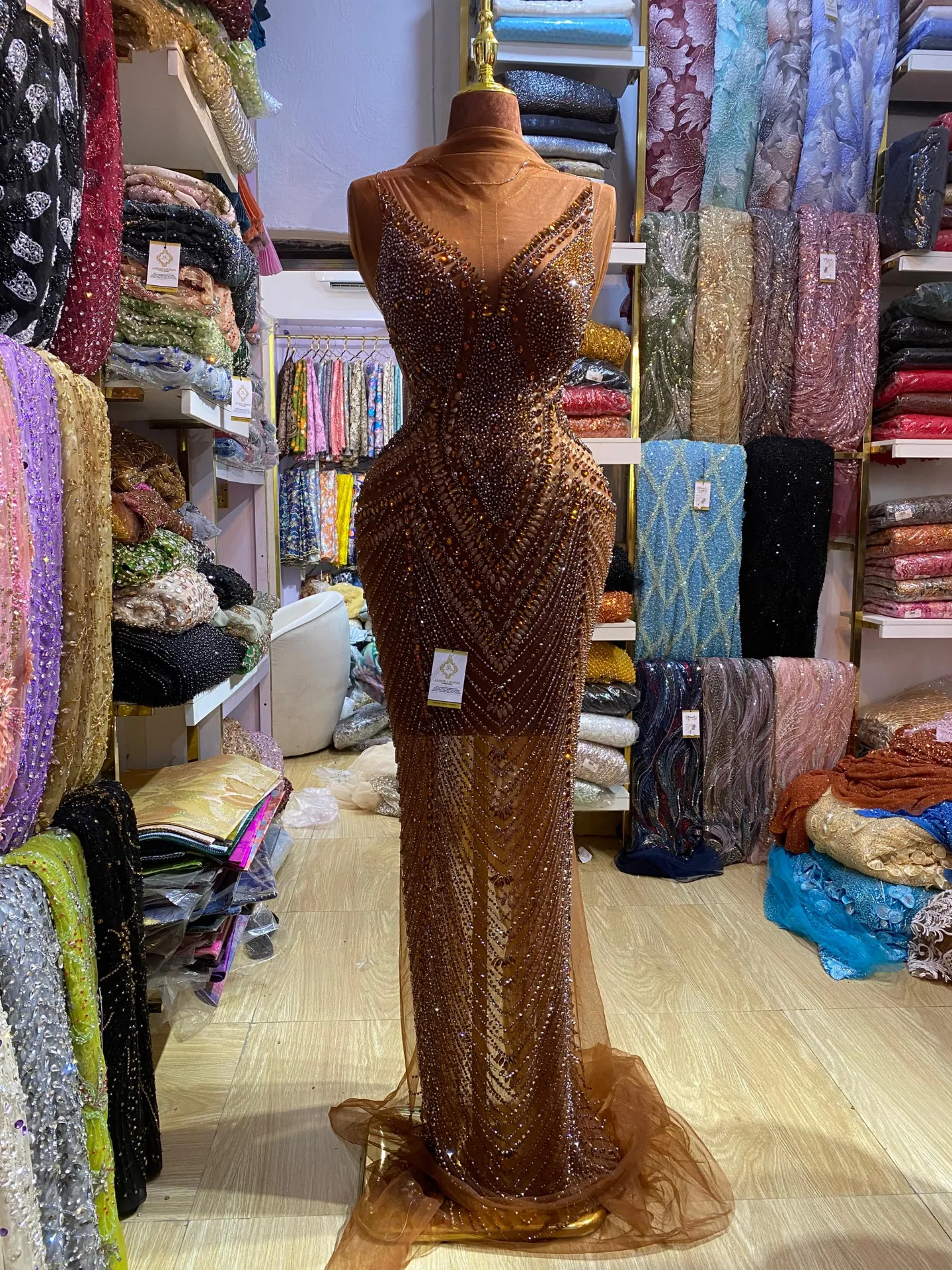
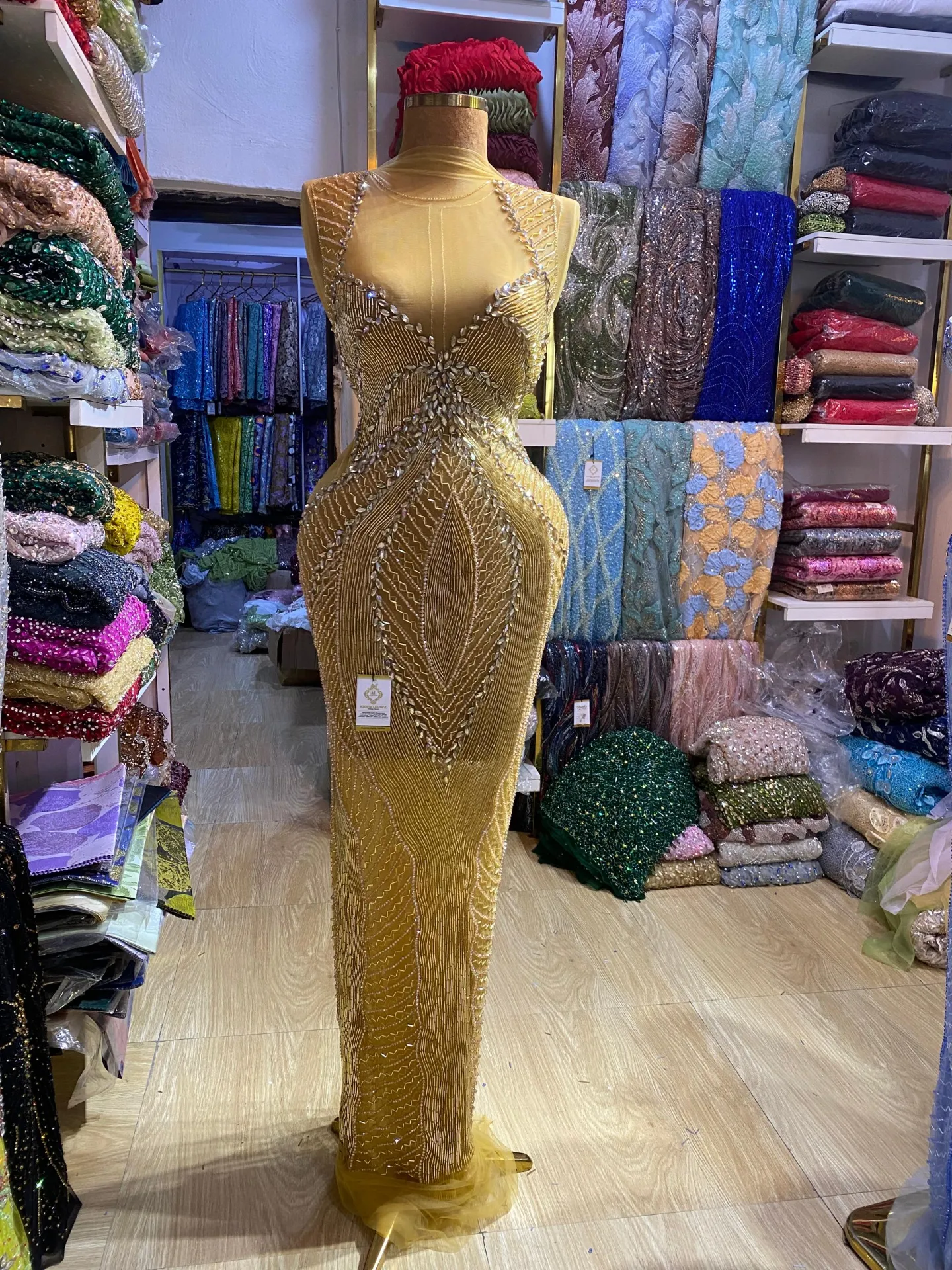
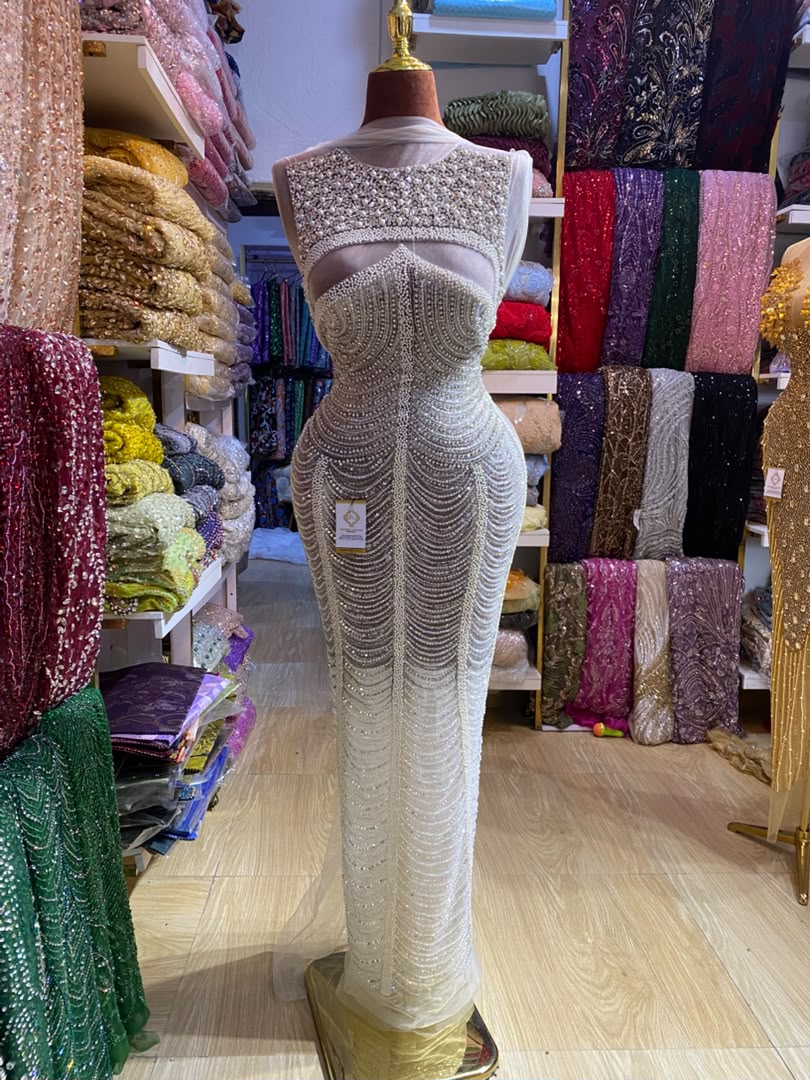
If you have ever marveled at an owambe gown that looks like a ₦500,000 custom couture creation—where the beadwork perfectly frames the collarbones, tapers into a snatched waistline, and blossoms into a dramatic scalloped floor hem without a single awkward seam through the embroidery—you were admiring panel dress fabric.
Historically, achieving this level of motif alignment required an artisan to spend three to four months hand-beading individual appliques directly onto a fitted dress form. Textile engineers in Switzerland, South Korea, and France revolutionized the industry by programming industrial multi-head looms to weave complete, architectural dress panels in one continuous piece. For Nigerian brides, celebrants, and fashion designers, panel fabric delivers red-carpet bespoke drama with zero hand-beading delay.
1. The Anatomy of an Engineered Panel: Zone by Zone
When you unroll a genuine panel fabric across a cutting table, you are looking at an engineered canvas divided into three distinct anatomical zones:
Panel Dress Fabric vs Standard All-Over Repeating Lace
| Design Attribute | Panel Dress Fabric | Standard All-Over Repeating Lace | Tailoring Impact |
|---|---|---|---|
| Pattern Layout | Pre-engineered placement (bodice, waist, hem) | Continuous repeating all-over grid or floral | Panel eliminates awkward motif cuts across chest |
| Cutting Protocol | Pattern pieces must lock into built-in zones | Flexible; can cut anywhere along grainline | Panel requires master cutting skills; zero room for guesswork |
| Visual Aesthetics | Looks like a bespoke ₦500k runway gown | Traditional, uniform, and classic | Panel creates an intentional, snatched hourglass silhouette |
| Selling Unit | Sold as a complete dress panel (2.5y – 3.5y) | Sold per running yard or 5-yard bundle | Panel provides exact material for 1 complete gown |
| Ideal Silhouettes | Mermaid, trumpet, column, corseted sheath | Iro & buba, flared A-line, kaftans, multi-ruffles | Panel is designed specifically for fitted floor-length gowns |
| Wastage Risk | Severe if cut incorrectly by an apprentice | Minimal; scraps can be repurposed for sleeves | Never give panel lace to an untrained neighborhood tailor |
| Price Range (Nigeria) | ₦85,000 – ₦250,000+ per panel piece | ₦45,000 – ₦180,000 per 5-yard bundle | Reflects specialized multi-head loom engineering |
2. Five Showstopping Silhouettes Built from Panel Fabric
Because the motifs are pre-placed, panel fabrics lend themselves to specific high-impact silhouettes. Fashion designers in Lagos, Abuja, and Port Harcourt excel at crafting five primary styles:
3. The 5 Golden Rules for Tailors Before Cutting Panel Fabric
Critical Cutting & Assembly Protocol
- Rule 1: Always Measure Finished Length with Event Heels On: Never cut a panel until the client wears the exact heel height intended for the event. If the dress turns out too long, you CANNOT hem it from the bottom without slicing off the expensive border. Any length adjustment must be made at the waistline seam or shoulder yoke.
- Rule 2: Fold Precisely on the Center-Front Symmetry Axis: Lay the panel flat on a wide cutting table. Pin the mirrored motifs along the center line before placing pattern paper. An off-center cut of even 1 inch will make the neckline look crooked.
- Rule 3: Preserve Scalloped Border Off-Cuts for Sleeves: Do not discard off-cuts from the bottom border. A master tailor uses these border strips to create matching scalloped sleeve cuffs, choker collars, or back waist accents.
- Rule 4: Reinforce with Spiral Steel Boning: The weight of the lower border will pull down on the waistline. An internal waist stay ribbon (grosgrain) and spiral steel boning inside the lining are mandatory to support the gown.
- Rule 5: Use Plain Illusion Mesh for Side Seam Extensions: If the client measurement exceeds the width of the panel, insert plain dyed-to-match tulle along the side seams under the arms rather than splitting the central front motif.
Featured Darlings Luxury Panel Collections
Recreate the editorial look with curated Darlings Fabrics picks.
Shop Collection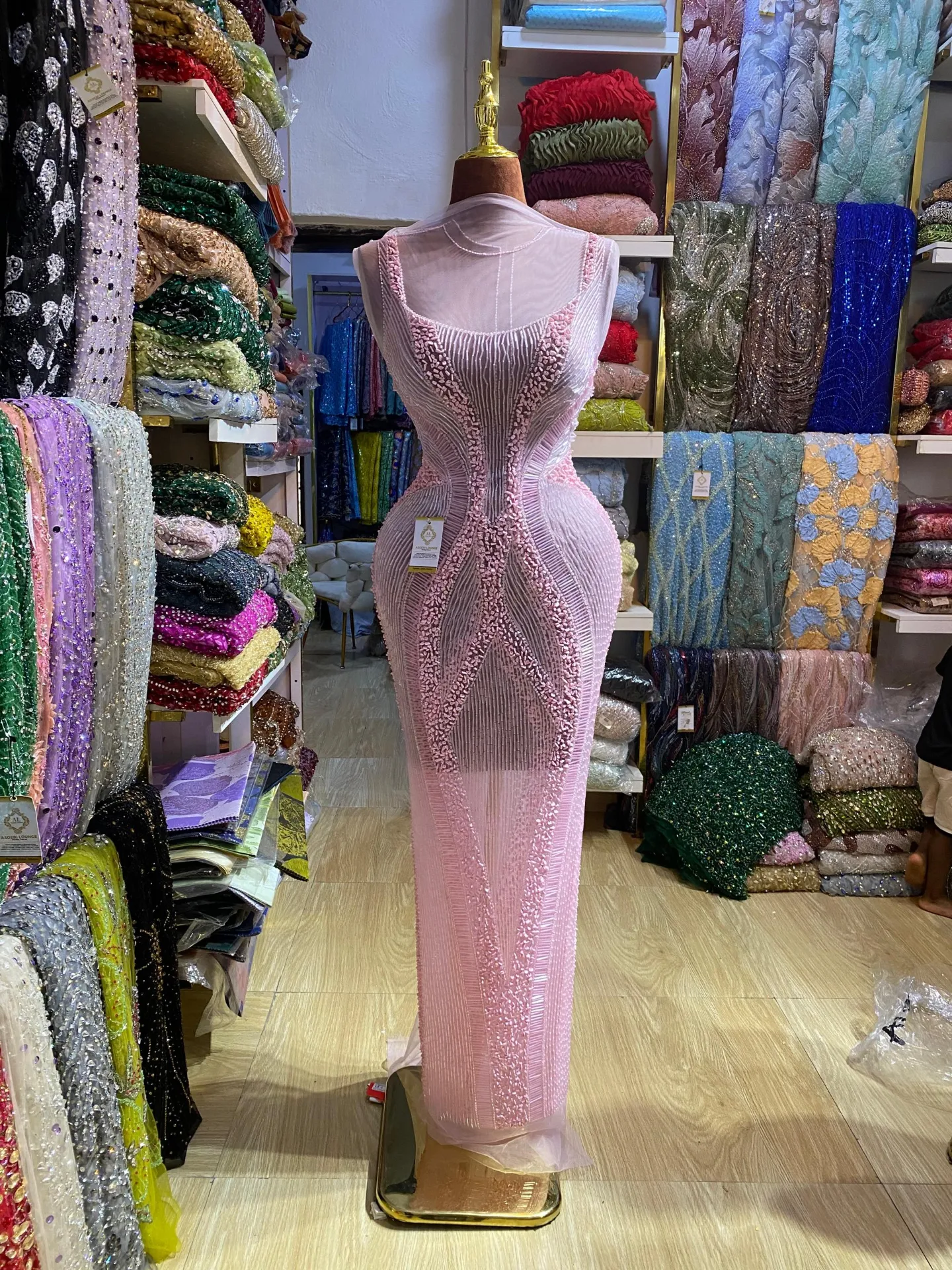
4. Questions to Ask Your Tailor Before Handing Over a Panel Cut
Before entrusting a ₦150,000 panel fabric to your fashion designer, ask these four diagnostic questions:
Tailor Vetting Checklist
- "Where will you take up the length if the gown is too long for me?" Correct answer: At the waist seam or shoulder line. If they say "from the bottom," they will destroy your scalloped border.
- "Will you do a muslin toile fitting first?" A professional designer will draft a test toile in cheap calico or satin to test the fit before cutting into your luxury panel.
- "How will you support the weight of the border hem?" They should mention internal waist stays, horsehair braid, or structural boning.
- "Can you show me previous panel gowns you have cut?" Request photos of past client work to verify they understand motif symmetry.
Frequently Asked Questions
Frequently Asked Questions About Panel Dress Fabrics
Can you make a two-piece outfit from panel dress fabric?
Yes! A skilled designer can cut the top engineered section as a fitted corset or crop blouse, and use the lower border section for a high-waisted pencil skirt or tulip wrapper. However, one-piece floor-length mermaid gowns remain the most popular and breathtaking use.
How many yards is a standard panel dress fabric?
Panel fabrics are typically manufactured as single garment panels measuring between 2.5 to 3.5 yards in length with a standard width of 52 to 54 inches. This provides sufficient length for a full floor-length gown with sleeves and a modest train for individuals up to 6 feet tall in heels.
Do I need extra fabric for a full cathedral train?
Yes. If you desire a dramatic 2-meter or 3-meter sweeping train, the panel itself will cover the front and immediate back hem. Your tailor will need 2 to 3 yards of coordinating matching illusion net, Duchess satin, or organza to construct the extended train godets.
What lining works best under panel lace?
We recommend stretch Duchess satin, medium-weight silk crepe, or 4-way stretch mesh. Stretch linings allow the gown to mould closely to your curves while preventing strain on the delicate embroidery threads of the panel.
Can a panel fabric be worn for traditional engagement weddings?
Absolutely. Many modern Nigerian brides choose a panel gown in royal gold, wine, or emerald for their traditional engagement ceremony or introduction. It offers a contemporary, snatched alternative to the traditional wrapper while honoring rich cultural embellishments.
What happens if I am petite (under 5 foot 3 inches)?
If you are petite, a skilled tailor will shorten the gown by removing height from the plain transition zone between the waist and knee. This preserves both the chest bodice motif and the scalloped hem border intact.